
Build your singing from the ground up
If you are thinking about singing posture, breath support, vocal technique, alignment, tension or how to sing with less effort, it is worth starting one step earlier than you might expect. Before asking how well you are breathing, where you are supporting, or what your voice is doing, ask a more fundamental question: how is your whole body organised for singing?
At the beginning of a new academic year, this seems a particularly good place to start.
Most of us return to our singing after the summer feeling a little rusty. Perhaps we haven't practised quite as regularly. Repertoire that felt secure in July needs finding again, and the voice may not respond immediately in quite the way we remember. It is very tempting at this point to start fixing things, when perhaps there is a more interesting place to begin.
The singer is the instrument
We can become very occupied with individual parts of vocal technique: the breath, the jaw, the tongue, the larynx, support, resonance. All of them matter, of course, but none of them operates independently of the rest of us.
The singer is the instrument.
It sounds obvious, but it is surprisingly easy to forget. Singing doesn't happen somewhere around the throat with the rest of the body providing a convenient means of carrying it around! It involves a remarkably sophisticated coordination of the whole human being.
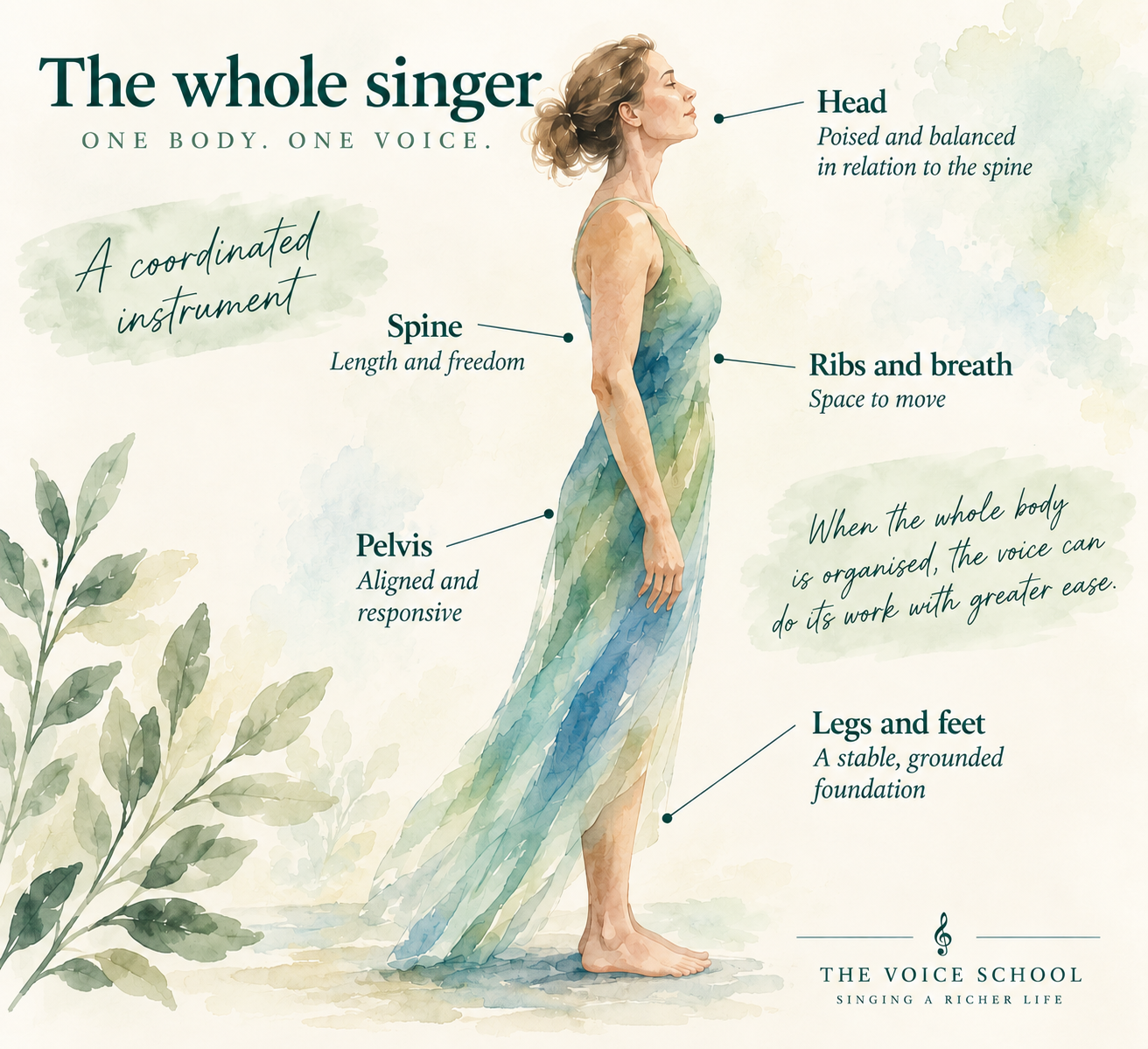
The breathing mechanism needs freedom to move, the ribs and trunk need to respond, and the head needs to balance in relation to the spine. The larynx needs to be free to do its work without unnecessary interference, while muscles throughout the body are continually responding, lengthening, balancing and supporting.
So, before we start trying to improve the breath, it makes sense to look at the body in which that breath is happening.
More than ‘good posture’
I have always been a little wary of the words good posture. They can so easily suggest that there is a correct position into which we should place ourselves before we sing.
Stand tall. Shoulders back. Chest up.
And before we know it, we can end up holding ourselves in an attempt to look like somebody who is standing correctly.
I prefer to think about our upright design. The human body already possesses a remarkably sophisticated system for balancing itself in an upright position, so we don't need to manufacture that support before we sing. What we can learn to do is become more aware of it and, importantly, notice some of the things we do that interfere with it.
What happens if the knees are locked? What happens if the pelvis is pushed forwards or backwards, or the chest is being held up? And what happens when the head is pulled backwards or the chin begins to reach forwards?
These aren't simply questions about appearance. Change one part of the organisation and other parts have to respond, which is why the relationship between the head and spine is particularly interesting. When there is balance and length rather than holding, the breathing and vocal mechanisms have a much better chance of doing their work without unnecessary effort.
This is where posture becomes much more interesting than simply something we ‘do’ to ourselves before taking a breath. It is part of the conditions in which breathing and singing happen.
The art of allowing
There is a phrase I use quite often in my teaching: the art of allowing.
That doesn't mean being passive. Singing requires energy, intention and considerable physical engagement, but engagement and interference are not the same thing, and sometimes our very determination to sing well persuades us to add more and more activity.
We take an enormous breath. We lift the chest. We hold the abdomen. We arrange the mouth. We position the head. By the time we have prepared ourselves so thoroughly for the first note, the body may have rather a lot to undo before it can actually sing!
This is where learning to sing becomes fascinating, because progress doesn't necessarily come from finding another thing to do. Sometimes the discovery is that the jaw doesn't need to be held, the neck doesn't need to brace itself, the chest doesn't need to be lifted or the breath doesn't need to be dragged into the body.
The more aware we become of the whole instrument, the more there is to notice.
My Essential 5
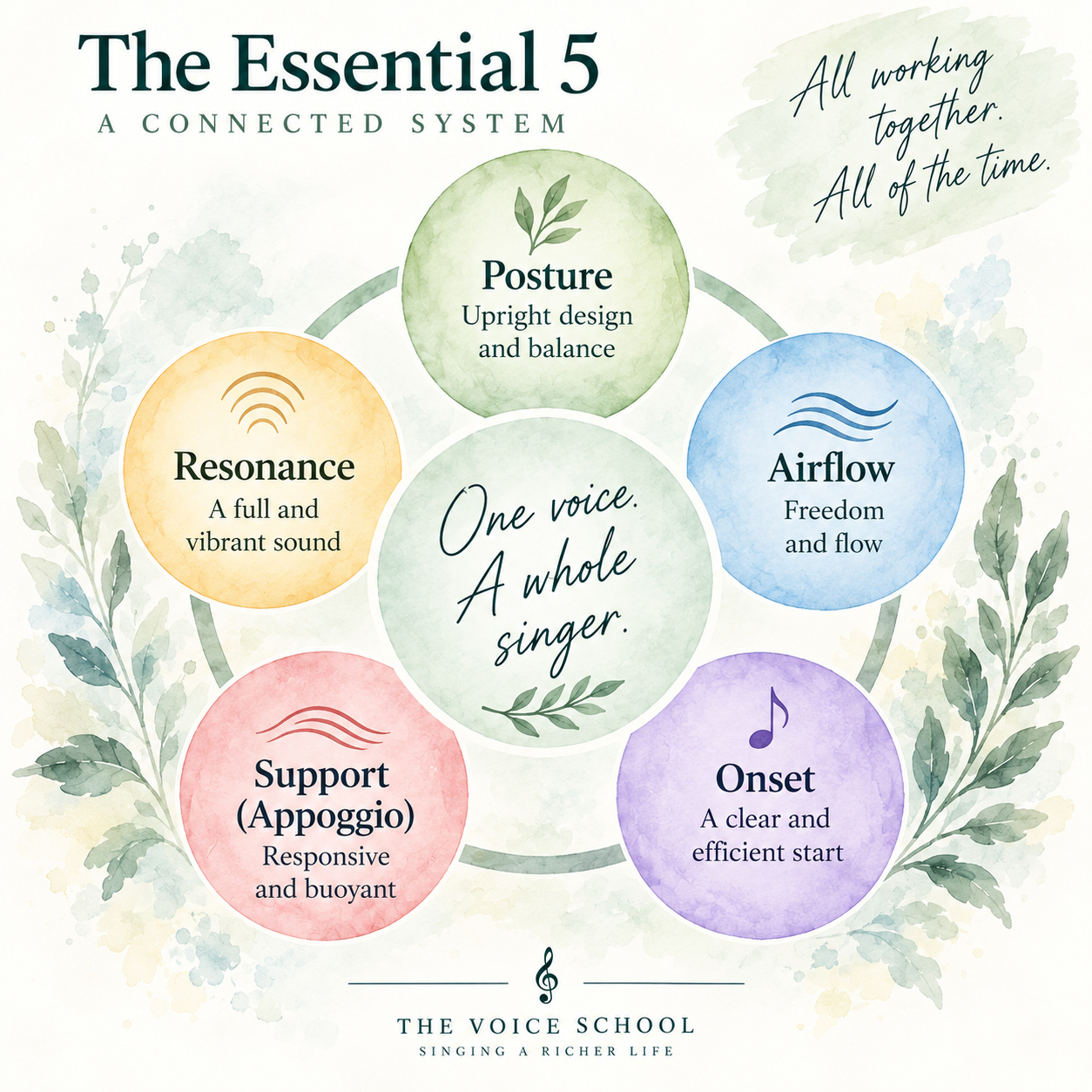
My own approach to vocal technique rests on what I call the Essential 5: Posture, Airflow, Onset, Support/Appoggio and Resonance.
I separate them because it gives us a useful way of studying what is happening. The voice, of course, doesn't know that we have put its workings into five convenient categories. They are all happening together, all of the time.
Posture affects the freedom of the breathing mechanism. Airflow and onset meet at the beginning of sound. Support responds to the demands of the phrase, while resonance depends upon the freedom and coordination of the system as a whole. Alter something in one area and it is quite possible that something elsewhere will respond.
Perhaps this is partly why vocal technique can sometimes feel so baffling. We identify the place where we hear or feel the difficulty and quite reasonably assume that must also be where the answer lies. Experience tells me that it is always worth looking a little more widely.
Back to basics doesn't mean going backwards
I have taught singing for a long time, and I still find the basics endlessly interesting. In fact, the longer we sing, the more there seems to be to discover in them.
Our awareness changes. Our bodies change. Our repertoire makes different demands of us. Something we understood perfectly well in theory can suddenly make much more sense when we experience it physically, and returning to fundamentals can reveal things we simply weren't ready to notice the first time around.
A period away from regular singing can be rather revealing too. As we begin again, we have an opportunity to notice what we automatically put back: the familiar habits, the helpful ones and perhaps a few that aren't helping us quite as much as we thought they were.
At the start of this new Voice School year, this is very much where my thoughts are heading. We have a whole year of repertoire, study and singing ahead of us, but before becoming absorbed in all the fascinating musical and expressive questions that repertoire will bring, there is real value in returning to the instrument itself and looking again at how all its different elements work together.
Build from the ground up
So perhaps begin very simply.
Stand for a moment and notice your relationship with the floor, without immediately correcting anything. Where is your weight? What are your knees doing? What do you notice through the pelvis and back, and where is your head in relation to the rest of you?
Then allow yourself to breathe and make a sound.
You may notice something. You may not. Either is useful, because the point isn't to achieve the ‘right’ posture. It is to become more curious about the relationship between the way you organise yourself and the sound you make.
That is the kind of curiosity I hope to keep bringing to our work throughout the coming academic year. Posture, airflow, onset, support and resonance give us useful points of reference, but ultimately we are interested in the way they come together in one voice, one body and one singer.
Before trying to fix the voice, consider the whole singer.
A little more from the archive
If this has encouraged you to go back to your own vocal foundations, you might enjoy revisiting my earlier Take Note post, Vocal basics every classical singer should know. I've brought it out of the archive because it explores the Essential 5 in more detail and includes one of my existing YouTube channel vocal technique videos.
Sometimes the beginning of a new singing year is exactly the right moment to return to something we thought we already knew.
Curious about singing basics? Let's get you started with the right learning tools.
Download my free need-to-know vocal essentials guide for singers, vocal technique principles simply explained.

Your Desert Island Songs
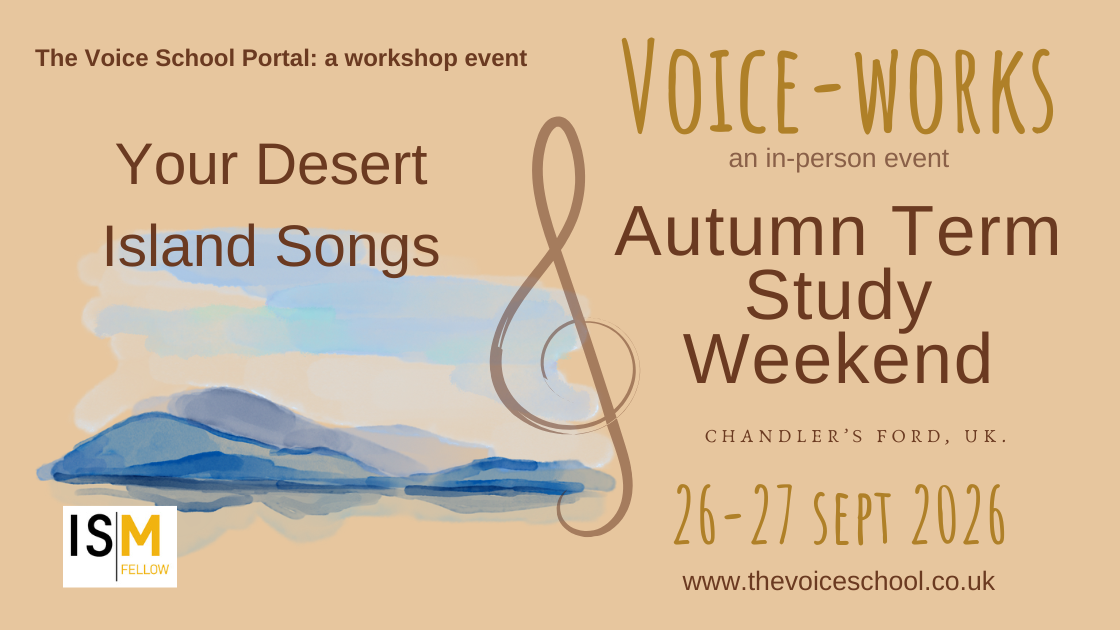
26–27 September 2026 · Chandler’s Ford, Hampshire. Explore the songs that become part of who we are as singers, in the company of other curious classical singers.
Singer applications have now closed. Observer places are available.
New! August Intermezzo
A short interval or pause between larger events.
Running from 3–28 August, this is a new kind of Studio 5 space for the holiday weeks between terms - an online Intermezzo where you can stay connected to your singing in a simple, practical, and flexible way, even if life is busy or if you’re away.
Alongside weekly material, I’ll set aside time each week for an open, informal Intermezzo chat — you can drop in to ask questions, share ideas. If you can’t make a live chat, you’ll still be able to send thoughts and questions into the group space for me to respond to during the week.
This August Intermezzo is the first of a new Studio 5 idea that will continue to appear during the spaces between terms across the academic year.
Repertoire that meets you where you are.
A curated, confidence-building guide for returning, rebuilding, or refining classical singers. Includes expert commentary, a clickable playlist, and clarity on how to choose songs that truly fit. Instant download.
The Classical Singer's Path
A new Substack series, written from the inside out - glimpses into my own life as a classical singer, and the way I think about the art we share. It is quieter than the bustle of The Voice School, a place for reflection, stories, and ideas that might travel with you into your own singing life.. It’s free to subscribe, and early support means a lot as I get it going. You’re warmly invited to join me there.

Featured in Feedspot
Ranked #29 in their Top 60 Singing Blogs — a lovely recognition of our reflective approach to singing.
Stay connected with new events and all updates!

Singing Basics Guide
Getting to grips with or making improvements to your singing and the methods to achieve progress are all far easier and more accessible than you think.
