Voice-works End-of-Year Study Weekend: Eight Vocal Greats
11 – 12 July 2026 – Chandler's Ford, Hampshire, UK.
VoiceWorks End-of-Year Study Weekend: Eight Vocal Greats
A two–day exploration of eight pivotal composers whose vocal writing shaped the art of singing across three centuries. Thoughtful study with space to explore repertoire that supports both reflection and development.
Singer applications close Friday, 15th May 2026
A lineage of vocal thinking.
What fascinates me about these eight composers is not simply their individual greatness, but the way they sit in time. With one striking exception, the chronological line is almost unbroken. Each composer was still living when the next was born, each arriving into a musical world already shaped by what had gone before. In that sense, vocal writing is handed on rather like a baton, received, tested, questioned, and then carried forward in a new direction.
Purcell sets the line in motion, grounding vocal music in clarity of text and expressive purpose. Bach and Handel are born into that world and deepen it, each in their own way, strengthening the relationship between structure, rhetoric, and vocal line. Mozart inherits this musical landscape fully formed, and transforms it from within. With him, the voice becomes inseparable from character and inner life, singing is no longer just shaped sound, but human intention made audible.
Then the line breaks. Mozart dies before Bellini is born, and the world between them changes profoundly. Europe is reshaped by revolution and the Napoleonic wars, and the assumptions that once governed music, society, and art are unsettled. When Bellini arrives, the voice is asked to do something different. His long, suspended melodic lines suggest a new emotional climate, one that requires patience, breath, and a different kind of expressive generosity. Verdi, born into that same altered world, takes the baton and runs with it, intensifying the demand for dramatic truth and moral weight in vocal writing.
From there, the thread continues. Debussy loosens the inherited rules again, reshaping how harmony, colour, and speech serve the voice. And Britten, born into the musical world Debussy helped to open, draws the line back towards text, character, and psychological clarity, but with a modern ear and a distinctly personal voice.
Seen this way, these composers form a continuous, human story rather than a list of styles. This weekend invites you to trace that line, to notice how vocal expectations shift from one generation to the next, and to place your own repertoire choices within that unfolding narrative. It’s a chance to step back at the end of the year and see how voices, including your own, are shaped by what they inherit and how they choose to carry it forward.
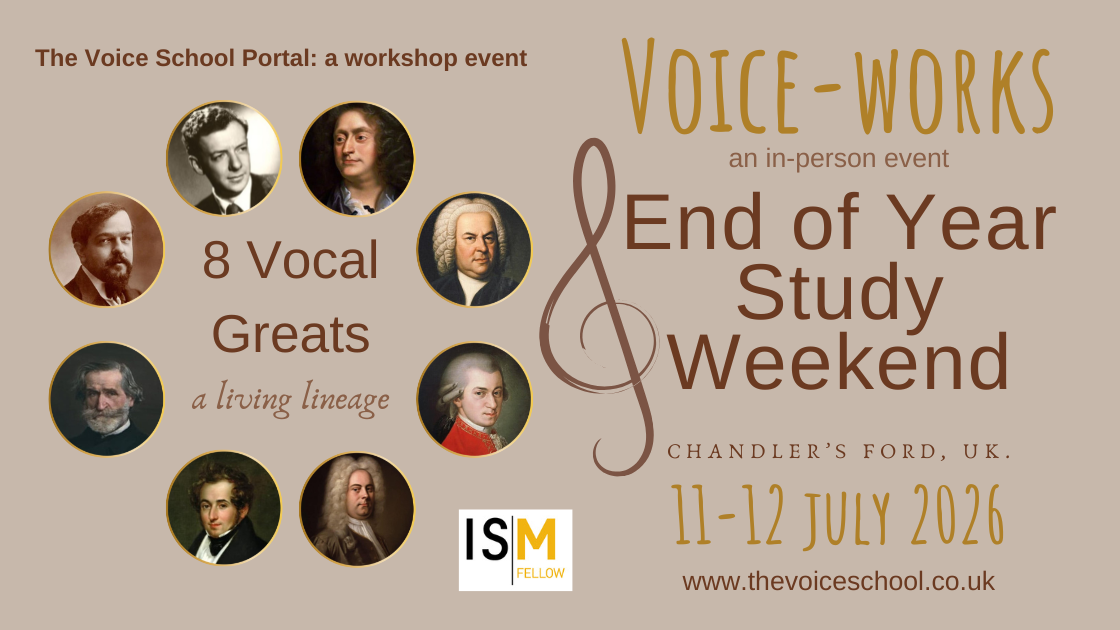
Who’s in the lineup?
Here are the eight composers we’ll be working with across the weekend — each offering singers distinct artistic challenges and rewards, not just technically, but in how they think about sound, text, and intention.
Henry Purcell
Purcell was one of the first to give vocal writing a profound, expressive character rooted in text and rhetoric. His music sets a foundation of clarity and communication that still informs our understanding of voice today.
Johann Sebastian Bach
Bach’s vocal writing is architectural in its precision and integrity. Whether in sacred works or intimate songs, his music demands linear clarity and deep musical responsibility, creating a framework that underpins so much that comes after.
George Frideric Handel
Handel brought drama to the forefront, merging Italianate vocal technique with expressive ambition. His vocal works expand the emotional range and text-driven drama that singers still respond to and learn from.
Wolfgang Amadeus Mozart
Mozart refined the art of vocal balance and dramatic honesty. His operatic and sacred writing places character and intention at the heart of every phrase, teaching singers how to inhabit a line with purpose.
Vincenzo Bellini
Bellini’s bel canto melodies gave voice a sustained, lyrical sweep. His long lines require patience, breath control, and expressive nuance, representing a shift toward vocal emotional language that is deeply connective.
Giuseppe Verdi
Verdi’s vocal writing is honest and human. His music confronts drama with unflinching clarity and textual integrity, asking singers to speak truthfully through sound — regardless of size or genre.
Claude Debussy
Debussy reshaped how harmony and colour support the voice. His vocal writing reflects a new way of hearing text and line together, dissolving predictable phrase shapes and inviting singers to think in colour and gesture.
Benjamin Britten
Britten makes text and voice inseparable. Writing in a world Debussy helped open, Britten’s music prioritises speech rhythm, psychological detail, and modern clarity, continuing the lineage into the contemporary voice.
What you’ll be preparing
You’re invited to bring up to six pieces drawn from these eight composers, choosing repertoire that genuinely speaks to you at this point in your singing. Some may be old friends you want to revisit and take further; others may be current studies, or pieces that have been on your mind for a while. A mixture often works well.
There is no expectation that these should all be new pieces. In fact, that would be too much. This is an opportunity to look back over your recent singing and choose repertoire that has meaning for you now, whether that comes from familiarity, curiosity, or a sense that there is more to discover.
The composers themselves have been chosen because of how well they understood the voice. So as you make your selections, take a little care over what each piece offers you. It might ask for control of line, flexibility, range, text, or character. It might stretch something that feels just within reach, or bring something already known into sharper focus. The aim is not to collect pieces, but to choose ones that show something real about where you are in your singing, and where you would like to go next.
There is no expectation that everything be performance-polished. What I do expect is that whatever you bring is properly prepared. You should be able to sing it securely, without large sections still unknown. Backing tracks organised. Keys decided. Text understood. And, just as importantly, some sense of the context — when the piece was written, where it sits in the composer’s life, and why you have chosen it now.
Voice-works weekends work best when singers arrive ready. Not perfect, but prepared. That allows us to move quickly beyond notes and basics and into something far more interesting — how the repertoire is shaping your voice, your thinking, and your place within this longer vocal story as we draw the academic year to a close.
What to Expect
This is a Voice-works Study Weekend, which means the focus is on detailed exploration rather than presentation. We will be working with repertoire in depth, looking at what it reveals about your voice, your technique, your interpretative choices, and how those choices sit within a longer vocal lineage.
The workspace is supportive and generous, but also purposeful. Voice-works weekends work best when everyone arrives ready to engage, listen, and think alongside singing. Learning happens not only through your own repertoire sessions, but through shared listening and observing others at work. Curiosity, attentiveness, and a willingness to stay with the process are essential parts of the experience.
These weekends bring together historical context, vocal technique, and artistic thinking. Because the groundwork has already been done, we are able to move beyond notes and basics and into interpretation, freedom, and musical decision-making.
We’ll be working in a small group (maximum five singers), which allows for focused work on each person’s repertoire without rushing. The depth of that work comes from the attention you bring to it, both in your own sessions and in the room as a whole.
Both days will take place in Ritchie Hall, Chandler’s Ford, a comfortable and welcoming space with generous acoustics. Please bring a packed lunch with you each day; hot drinks will be available throughout.
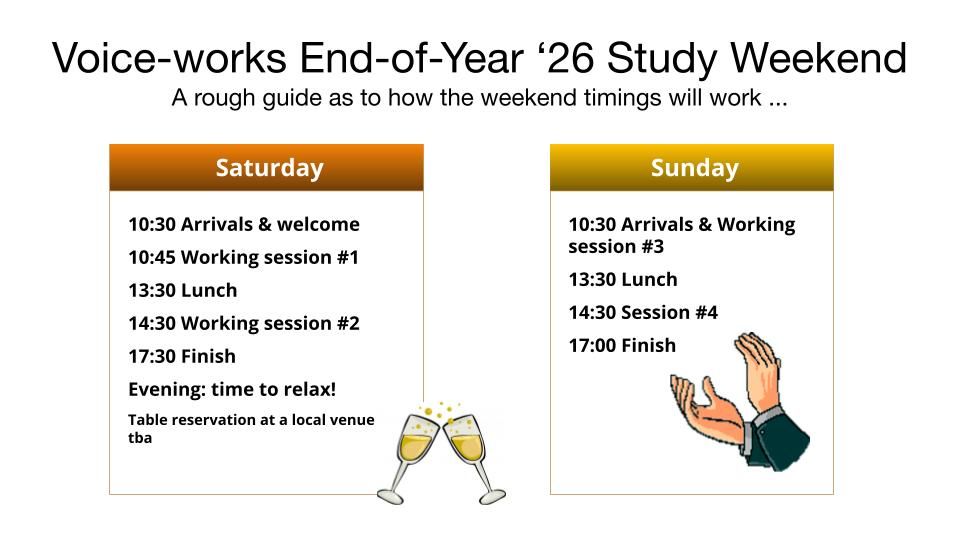
The Weekend at a Glance ...
Ready to join me?
How to Take Part / Sign Up
Singers
Singer places are limited to a maximum of five to keep the working group focused, connected, and supportive. If you’re applying as a singer, you’ll be invited to bring prepared repertoire and to take an active part over the weekend.
Singer places are £250 for the full weekend.
If spreading the cost would be helpful, you’ll also see an early bird payment plan available, offering the option to spread the fee across three instalments if booking before the end of April. As always with Voice-works events, places are limited to keep the working group focused and supportive.
Applications to come and sing will close as we break for Summer half-term, on Friday, 16 May 2026, or earlier if places are filled.
Observers
Observers are very welcome to join us on either day or both, 11/12 July 2026 at the Ritchie Hall, Chandler’s Ford. You won’t simply be sitting at the back watching. Your presence matters, and many singers find that observing closely — listening, following scores, and reflecting — is a valuable way of learning.
If you’re not ready to sing this time, attending as an engaged observer is a meaningful way to take part in the weekend.
Observer day passes are available at £20.
Still thinking about it?
If you’d like to keep in touch to receive updates about this and other Voice School events, you’re very welcome to join my mailing list by completing the form to the right. I send updates carefully and thoughtfully, always with singers like you in mind.
Stay in touch
See you inside The Green Room
Once you’ve signed up for the Study Weekend, I’ll be in touch personally to gather your thoughts and share all the logistical details. This will be a day (or weekend!) where we collaborate closely to create an experience that truly serves us as singers — positive, supportive, and focused on your growth.
To help keep us connected before, you’ll have access to The Green Room, our private online space where you can ask questions, share ideas, and get encouragement from me and the other singers. (Currently, this is hosted on Facebook, but I’m always looking for ways to make this space as welcoming and easy to use as possible.)
I’ll be with you every step of the way.
"It's essential to work on something you're deeply interested in. Interest will drive you to work harder than mere diligence ever could. The three most powerful motives are curiosity, delight, and the desire to do something impressive. Sometimes they converge, and that combination is the most powerful of all."
Source: How to Do Great Work