
Arrival
3–7 August
Giving yourself time to arrive physically and mentally before you begin to sing.
Trust
10–14 August
Learning to trust your developing ability and commitment to the art of singing.
Living
17–21 August
Keeping singing woven into everyday life - listening, learning, creativity and curiosity.
Meaning
24–28 August
Exploring thoughtful technique and a more meaningful communication.
The Intermezzo
was an opportunity to remain immersed in your vocal world without adding pressure or another programme to complete. Each week offered a different perspective, encouraging us to think a little more deeply about our singing, notice something new, and carry that awareness with us into ordinary life.
Our journey began with Arrival, considering how we come to our singing, physically and mentally. Trust turned our attention to the essential foundations we rely upon and the process that allows us to move beyond technique into music and text. Living broadened the picture again, exploring how singing becomes woven into everyday life through listening, learning, creativity and musical curiosity. Finally, Meaning brought those threads together, as we explored how technique, text, imagination and experience can work together to bring something to life.
Along the way, archive videos, postcards, ideas to reflect upon and thoughts from A Singer's Paradigm were joined by our informal Studio Conversations. Those conversations became an important part of the journey, allowing the weekly ideas to develop through questions, observations and shared experience.
Looking back across the completed month, Arrival, Trust, Living and Meaning became a connected journey, each one adding something to the next and giving us different ways of thinking about our voices, our musicianship and the place singing occupies in our lives.
I've left everything that follows just as it appeared week by week during August, so that you can return to the page and retrace the Intermezzo as it unfolded. The videos, postcards, reflections and conversations remain here for you to revisit, in your own time, for as long as this August Intermezzo page remains available.
Make sure you scroll right to the bottom of the page to catch all the content.

Arrival 3-7 August
Arrival is about giving yourself time to begin well. Before we ask anything of the voice, we need to notice how we are arriving today, physically and mentally. The way we begin often shapes everything that follows, and a few moments of preparation can make all the difference.
Starting here...
From the Virtually Vocalise archive
This short video snippet comes from one of our Virtually Vocalise vocal technique Live sessions. It's a snapshot of the kind of conversations we have as we prepare to sing, reminding us that good singing begins long before the first note. As you watch, notice how attention is given to arriving, recognising how you feel today, and creating the right conditions for the voice to do its work.
Trust 10-14 August
Trust is about returning to the foundations of healthy singing. Rather than chasing a result, we learn to rely on the essentials: posture, airflow, onset, support and resonance.
As those foundations become more familiar, they give us something dependable to work from, allowing our attention to turn more fully towards the music and the text.
More food for thought...
The only thing you can trust...
What are we really trusting when we sing? This reflection asks us to think about the order in which we work. Before becoming preoccupied with how we sound, the music or the text, our first attention needs to be on the physical process of singing:
Posture · Airflow · Onset · Support/Appoggio · Resonance
When those essentials are working together, resonance follows and our attention can move more fully towards the music and the text.
Living 17-21 August
Living is about allowing singing to become part of the way we listen, learn, think and create. Our musicianship grows not only through practising, but through curiosity, experience and becoming increasingly aware of the whole.
The more we immerse ourselves in the art of learning how to sing, the more our skills, understanding and artistic sensitivity can develop alongside one another.
More food for thought...
Awareness of the whole...
What do we really mean by musicianship? It is more than being able to read music, understand theory or learn the notes. This reflection takes a broader view: knowledge, skill and artistic sensitivity all have their part to play.
As singers, we develop through listening, learning, doing and experience. By immersing ourselves in the art of learning how to sing, we gradually become more aware of the whole: creativity, self-expression, communication and artistry, as well as the skills themselves.
Meaning 24-28 August
Meaning is where technique, text and imagination begin to work together. Our technical understanding is not something we learn first and then simply apply to a song; it becomes part of the way we think, feel and communicate through the music.
As technique becomes more dependable, there is greater freedom to respond to the text, trust our imagination and allow something individual and expressive to come to life.
More food for thought...
Bringing something to life
What happens when technique and imagination are no longer treated as separate parts of singing?
This reflection explores the relationship between vocal technique, text and imagination: sincerity and commitment to the words, direction of emotion, inflections of thought, interpretation, freedom, and the physical foundations that allow all of these things to work together.
The aim isn't to learn the technique and then “shoehorn it into a song”. It is to develop a synergy between what we understand technically and what we imagine artistically, giving us greater freedom to communicate and ultimately bring the song to life.
Thoughts along the way
'Warm up your mind before your voice.'
A Singer's Paradigm
One of the simplest things you can do this week is to notice how you arrive at your singing.
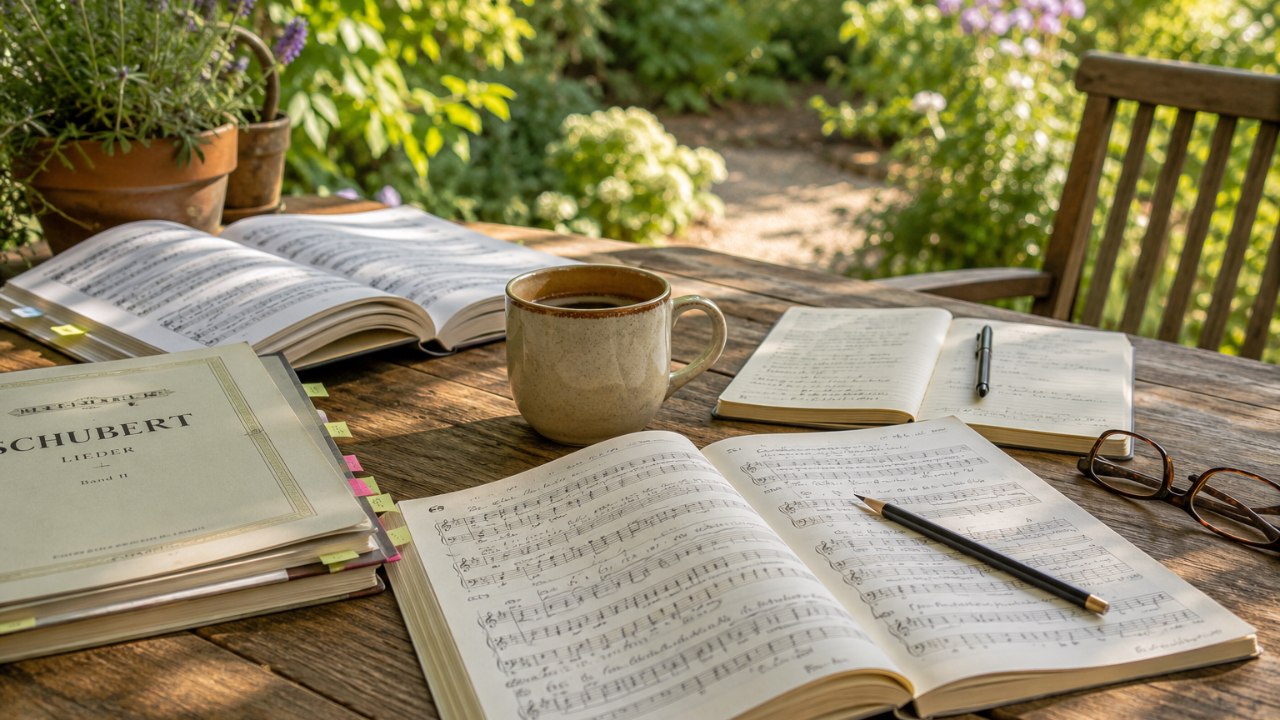
What helps you become ready? Is it listening to music? Reading the score? Sitting with a cup of coffee before you begin? Walking outside? Simply giving yourself a few moments before you sing?
There isn't a right answer. I'm simply inviting you to notice your own way of preparing, and what difference it makes when you give yourself that time.
‘Singing is the work of attention.’
A Singer’s Paradigm
Where does your attention go when you sing? It is very easy to become preoccupied with the sound we are making, or with everything we want to achieve in the music and text. But what happens if we reverse that thinking and bring our attention first to the physical process of singing?
Notice what happens when you return to the essentials you know: posture, airflow, onset, support and resonance. Rather than striving for a particular result, allow your attention to remain with the process and see where that takes you.
‘It's about becoming yourself.’
A Singer’s Paradigm
What does it mean to live as a singer? Perhaps it is less about finding enough time to practise and more about allowing singing and music to become part of the way we live, learn and think.
Listening, exploring repertoire, noticing other musicians, experimenting, being curious and giving ourselves time to develop all contribute to our musicianship. Skills and knowledge matter, but so do creativity, artistic sensitivity, self-expression and communication.
As we become more aware of the whole, perhaps the journey is not simply about becoming a better singer. It is also about becoming more fully ourselves.
‘Sing with your whole self.’
A Singer’s ParadigmWhat do we bring to a song when we sing? Technique matters, but technique alone is not the destination. The words, imagination, experience, instinct and our own response to the music all become part of what we communicate.
Perhaps singing with our whole self means allowing everything we have been developing to work together: trusting what we understand technically while remaining open to the text, the music and what they awaken in us.
As technique, imagination and artistic understanding begin to work together, we have greater freedom to communicate rather than simply produce the notes. Meaning comes when we allow something of ourselves to enter the song and bring it to life.
If you'd like to, make a note of anything you notice during the week. It might be a sentence, a question, a photograph, a quotation, a piece of music you've discovered, or simply a thought that has captured you.
From The Classical Singer's Path
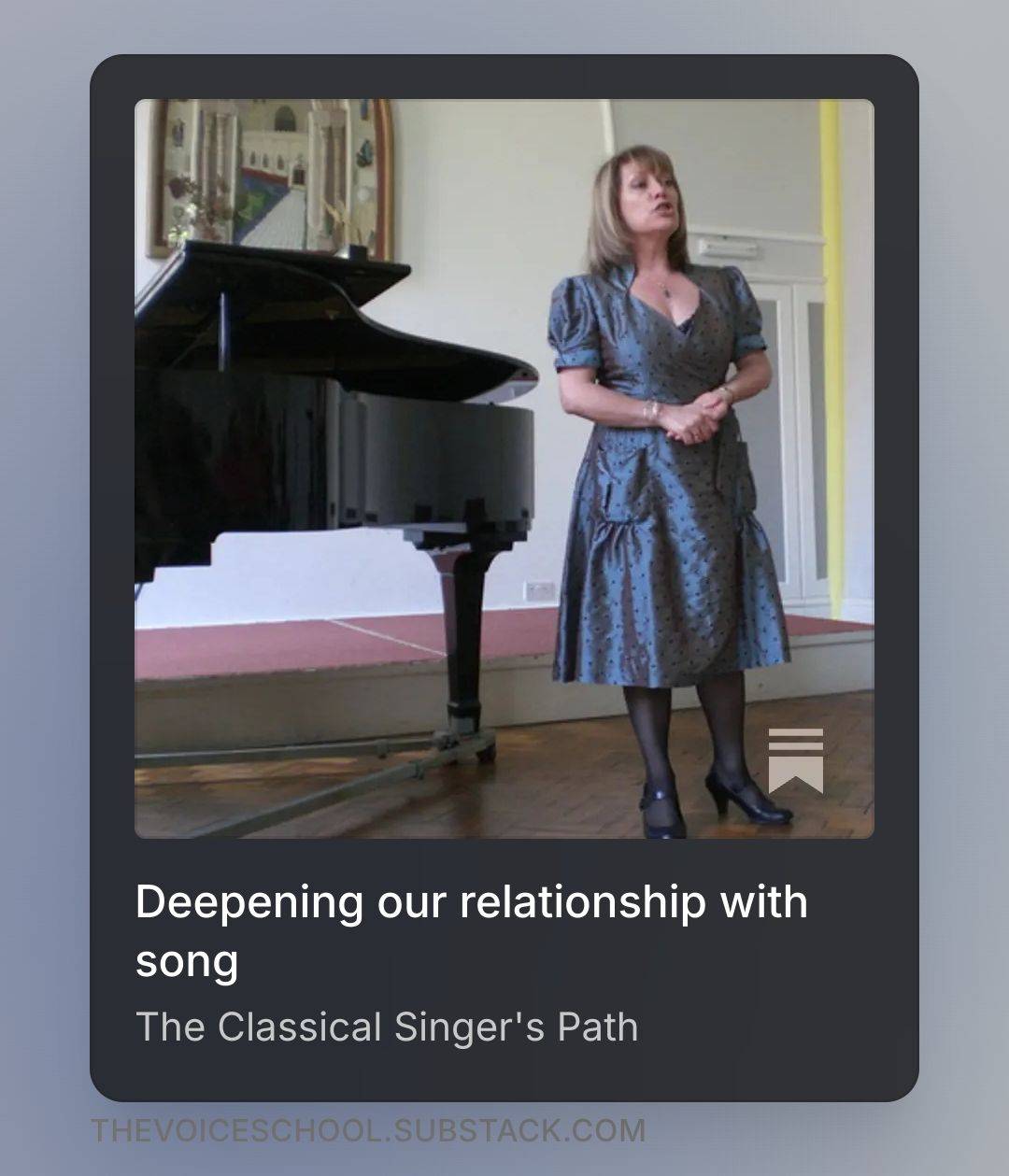
Deepening Our Relationship with Song
Some songs stay with us for years, revealing something new each time we return to them. My essay for August reflects on how our relationship with repertoire deepens over time, and why that journey matters as much as the destination.
Studio 5: in conversation

Our weekly Studio Conversations have now come to an end.
Thank you for joining me, for contributing your thoughts or questions, as they developed through Arrival, Trust, Living and Meaning.
Moments from each conversation are gathered below, and there's a fuller record of our discussions in Follow the conversation further down the page.
The conversations may be over for now, but the ideas they opened up are very much part of what we take with us from this inaugural August Intermezzo.
From our Studio 5 Conversations...
Arrival, 8 August 2026.
A few thoughts and reflections that came out of our first conversation:
“How do I start? What is my process?”
Gillian
We talked about the value of not simply launching into singing. Arrival can begin before we make a sound: finding our way into the right frame of mind, noticing the physicality of music-making, and giving ourselves time to become ready.
“Making sure your space is comfortable.”
Sue
Sue reminded us that preparation is practical too. The space in which we sing matters: having music ready and visible, clearing away distractions and creating a place that feels ready for the work can all become part of how we arrive.
“I really thought I'd lost control almost, but I haven't, have I?”
Sue
Perhaps one of the most interesting recognitions of the conversation. When life is busy or our normal routines have been disrupted, our singing may not have disappeared at all. Ideas, listening, repertoire and thoughts can still be developing in the background, even when formal practice has taken a different shape.
Trust, 15 August 2026.
Our conversation explored what happens as the foundations of singing become increasingly familiar and dependable:
“I haven't lost the stance, I haven't lost the exercise... it's a bit like riding a bike.”
Sophie
Returning to singing after a period without using her voice brought a reassuring discovery: the physical knowledge she had built was still there. The familiar process of preparing the body and voice gave her something dependable to return to.
“I'm just building and building and building that trust and confidence in the basics.”
Sue
Sue described how renewed attention to posture, vowels, onset and the physical process of singing was strengthening her confidence. Repeated, thoughtful attention to the foundations gradually makes them something we can rely upon.
“When I lose trust, I lose concentration because my brain is siphoned off with the anxiety.”
Sophie
This opened up the other side of trust. When anxiety about the result begins to take over, our attention can be pulled away from the process itself. Trust helps us keep our concentration where it can actually serve the singing.
Living, 21 August 2026.
Our conversation explored what it can mean to keep singing and musicianship alive as part of ordinary life, even when circumstances make formal practice difficult:
“The backbone of my life still is the music, still is the singing, no matter how little I do.”
Gillian
We talked about weeks when family life, work, travel or other circumstances make normal singing difficult. Singing does not necessarily disappear during those periods. Music can remain present through listening, thinking, looking at repertoire and allowing ideas to continue developing in the background.
“It is ticking over.”
Sue
Having initially felt that she had done nothing during a particularly difficult week, Sue realised that she had been listening to her own music collections and continuing to sort and reconsider repertoire. Living with our singing does not always have to look like formal practice.
“It forces us to listen differently.”
Sophie
Sophie reflected on what she had discovered during a period when she was unable to sing. Silence had made her listen differently and become much more aware of the support within the accompaniment. This led to a wider recognition that listening, reading poetry, studying and thinking are not substitutes for singing: they are part of the whole experience of being a singer.
Meaning, 27th August 2026
Our final conversation explored what happens when technique, music, imagination and experience begin to work together, and what that can make possible in our singing.
“No, it’s a whole thing.”
Sue
Sue reflected on her tendency to separate technique, physical understanding, music and emotion into different compartments. Although we may work on individual elements separately, ultimately they belong together as one experience.
“We stay vulnerable, otherwise we cannot really communicate, can we?”
Sophie
Meaningful singing always involves an element of risk. Technical security does not remove that vulnerability; it gives us something dependable enough to allow ourselves to communicate more fully.
“The process [is] more expanding, the approach is more varied, more open, less routine.”
Sophie
Looking back across the four weeks, Sophie recognised that her whole approach had widened, including how she thinks about repertoire and why she chooses particular songs. Sue expressed something similar: “Does this serve you?” had acquired additional meaning and given her a different set of criteria for thinking about her singing and repertoire.
Follow the conversation
Across the August Intermezzo, I've gathered together a fuller summary of each of our four Studio Conversations.
Arrival, Trust, Living and Meaning are now all included, tracing the ideas, questions and discoveries that emerged as our conversations developed across the month.
I've also added a final reflection arising from Sophie's observations during our End-of-Year Voice-works Study Weekend, looking more closely at the relationship between technique, communication and meaning.
If you'd like to revisit the journey as a whole, just click the image to read the complete document.
Thank you for spending some time with me in Studio 5 during this August Intermezzo.
Over these four weeks, we've explored Arrival, Trust, Living and Meaning, looking at our singing from different perspectives and allowing one idea to lead naturally into another.
As the Intermezzo comes to an end, perhaps the important thing is not to try to hold on to everything, but simply to notice what you are taking with you. A thought, a question, a different way of listening, a renewed awareness of your technique, or perhaps a clearer sense of the place singing occupies in your life.
The Intermezzo may be ending, but none of those things needs to end with August. They become part of what you bring with you when you next open your music and sing.
Until next time,
Gillian