
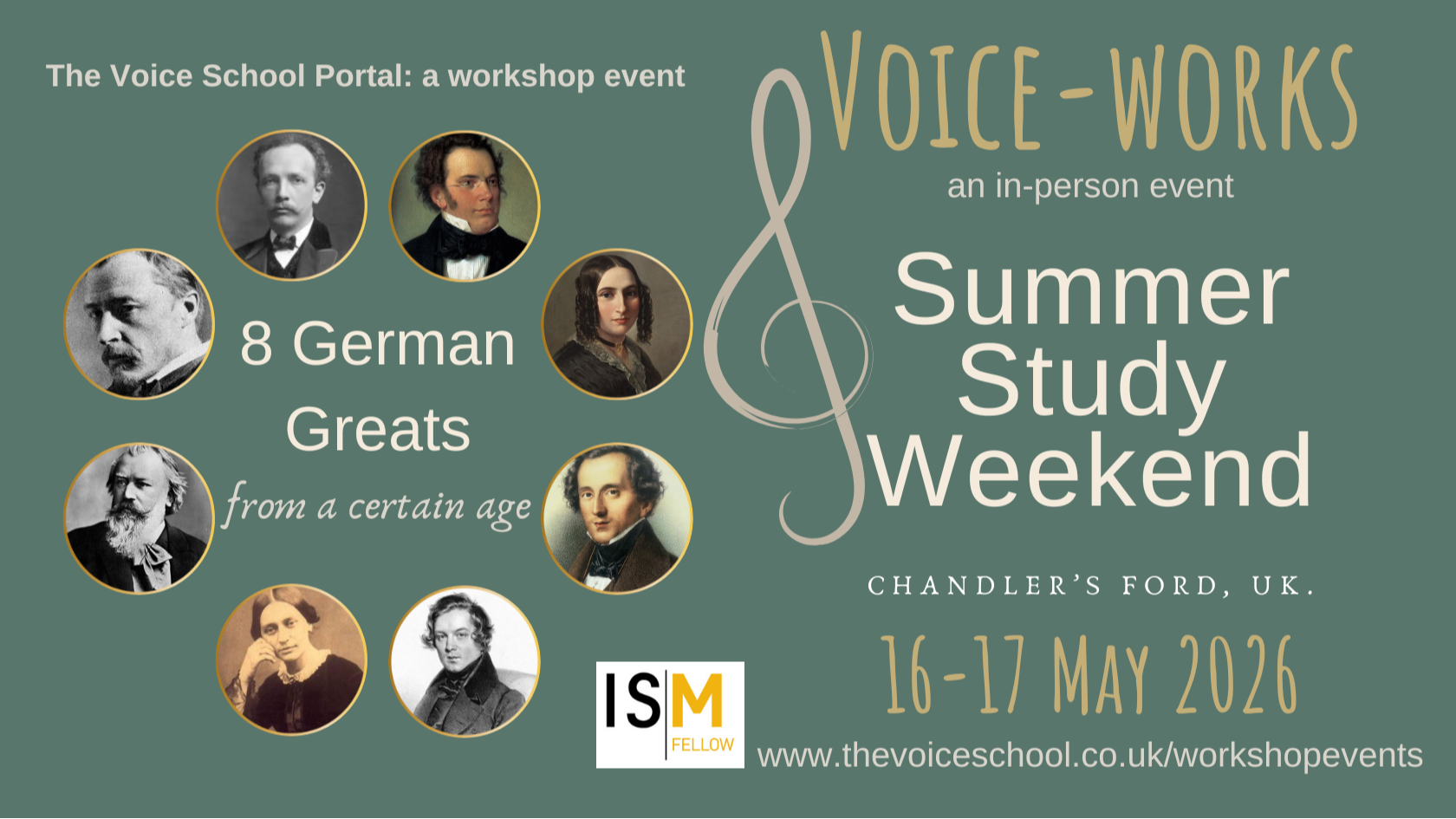
VoiceWorks Summer Study Weekend: Eight German Greats
16 – 17 May 2026 – Chandler's Ford, Hampshire, UK.
A two-day exploration of German lieder across nearly a century, from Schubert and the Schumanns to Brahms, Wolf and Strauss. Thoughtful, text-led music, rich in poetry and emotional depth, studied within a small group with space to work deeply and attentively on the repertoire you choose. Singer applications close Saturday, 28 March 2026
Why this repertoire? Why this era?
We’ll be spending time with eight German composers whose Lieder sit at the centre of the classical singing tradition. This is music singers keep coming back to — not only because it’s well written, but because it continues to teach us how voice, text, and musical shape work together.
These composers were chosen carefully for their lasting impact. Taken together, they trace a clear line from Schubert’s early Romantic songs, through the Schumanns and Brahms, and on to Wolf and Richard Strauss. Each one marks a particular stage in the development of German song, and each has written a wonderful repertoire that is ever relevant and worth continued study and inclusion.
Their music spans almost a century. What’s interesting is how much it has in common across that stretch of time. Poetry sits at the centre. Language matters. The voice is expected to communicate thought and feeling, not just sound. This is music that responds well to steady, attentive work.
The study weekend encourages you to work with music that supports and exhilarates you as a singer. Whether you’re thinking about legato, phrasing, tone, or your relationship with poetry, German Lieder offer a varied and demanding and necessary framework to explore.
And the women are part of the story. Fanny Hensel and Clara Schumann are here because their work demands recognition. We'll keep them alongside their contemporaries, as their work deserves the same careful attention.
These study weekends are about joining the dots — between composers, between periods, and between what you’re singing and what you’re learning. This exploration of German repertoire is an invitation to spend time with a tradition that vocally has much to offer.
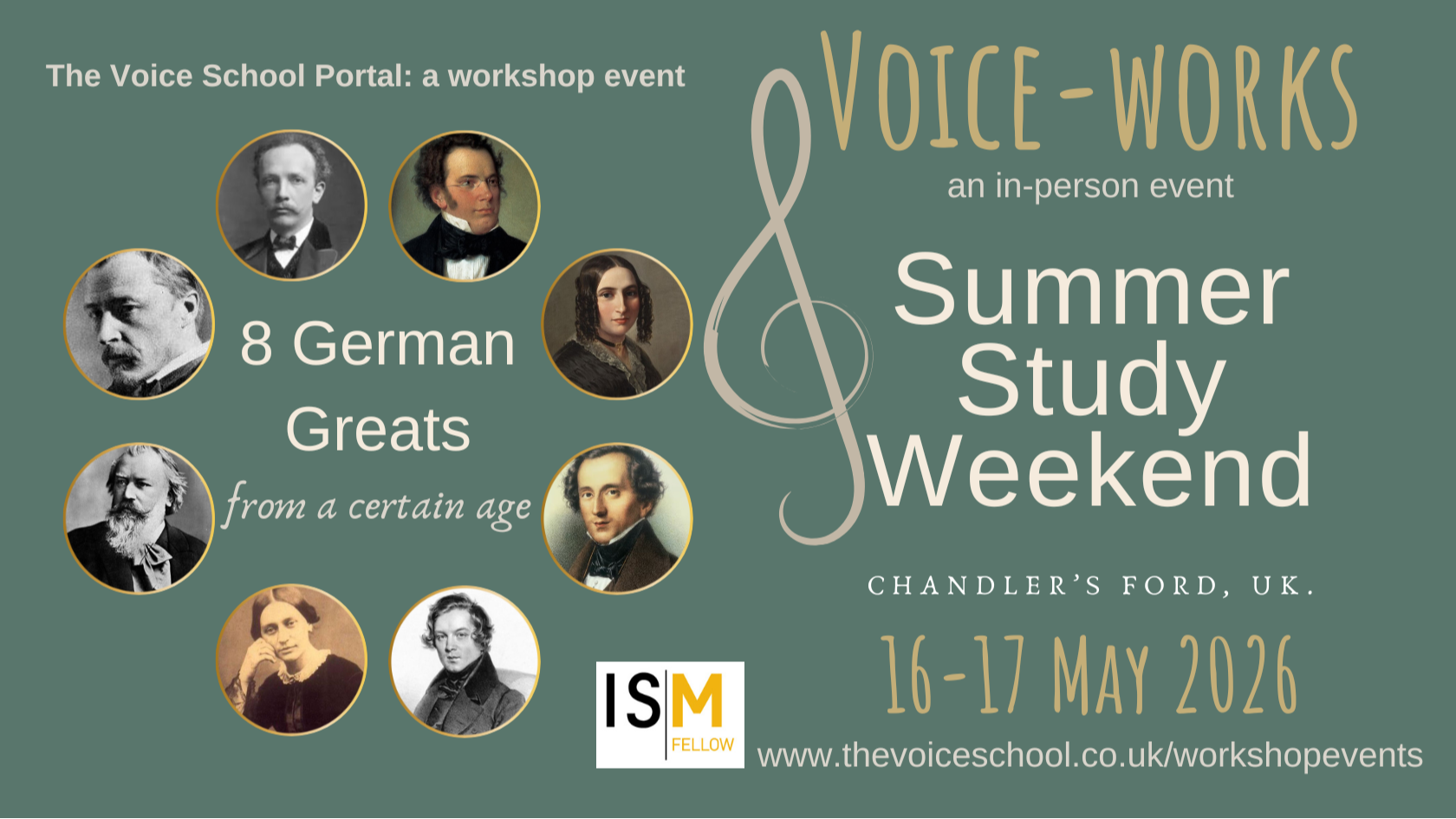
Who’s in the lineup?
Here are the eight German composers we’ll be focusing on across the weekend. Together they span almost a century of song writing, and each offers singers something distinctive — not just technically, but artistically and humanly — to spend time with and return to over a lifetime.
Franz Schubert
Schubert’s Lieder feel so natural that it’s easy to forget how radical they were. He was among the first composers to place the Lied at the centre of serious musical life, treating poetry and melody as equal partners. His writing asks the singer for simplicity, truthfulness, and deep attention to the text. Beneath the apparent ease of his melodies lies great emotional range and subtle musical thinking, making his songs endlessly revealing to live with and study.
Fanny Hensel
Fanny Hensel was an extraordinarily gifted composer whose output was shaped and limited by the expectations placed on her as a woman. Although she worked tirelessly and wrote a substantial body of music, much of it circulated privately, and some of her works were published under her brother Felix Mendelssohn’s name. Her Lieder are finely judged, expressive, and vocally natural, showing a composer with a strong individual voice and a deep understanding of poetry. Studying her work is both musically rewarding and long overdue.
Felix Mendelssohn
Mendelssohn’s lieder are marked by elegance, balance, and a strong sense of musical proportion. There is clarity in his writing, but also warmth and lyrical ease. His Lieder offer singers the chance to work on line, phrasing, and stylistic poise, and they sit comfortably between the Classical world he inherited and the Romantic language he helped shape.
Robert Schumann
Schumann approached song from the inside out. Poetry was central to his imagination, and his music often follows the emotional and psychological contours of the text rather than conventional musical structures. His Lieder can feel inward, questioning, and intensely personal, offering singers rich opportunities to explore nuance, colour, and meaning. This is repertoire that rewards curiosity and thoughtful engagement.
Clara Schumann
Clara Schumann was one of the most remarkable musicians of her time — a celebrated pianist, a perceptive musical thinker, and a composer of real substance. Much of her creative energy was absorbed by her responsibilities as a performer, teacher, and supporter of her husband, Robert, often at the expense of her own composing. Her songs are concentrated, expressive, and beautifully shaped, written by someone who understood the voice intimately. They deserve to be studied and valued on their own terms, not as a footnote to someone else’s career.
Johannes Brahms
Brahms is sometimes thought of as severe or heavy, yet his Lieder often reveal great tenderness and warmth. He wrote with deep respect for the voice, creating long, generous lines supported by rich harmonic language. His Lieder invite patience and trust, and over time they reveal a quiet beauty and emotional depth that can feel profoundly moving. This is music that grows with the singer.
Hugo Wolf
Wolf’s songs are shaped directly by the poetry that inspired them. He had an intense relationship with text, and his music responds closely to every nuance of language and meaning. His Lieder can feel demanding at first, requiring precision, clarity, and confidence, but they offer an extraordinary expressive range once the singer settles into the style. Wolf rewards commitment and careful attention.
Richard Strauss
Strauss brought a sense of expansiveness and colour to song writing, often favouring the female voice and writing with a strong understanding of vocal possibility. His songs can be technically challenging, but they are also generous, offering singers space to explore breadth of line, tonal richness, and emotional openness. When approached with a thorough, integral understanding, they can feel exhilarating to sing.
What you’ll be preparing
You’re invited to bring up to four songs, each by a different composer from the main lineup. When selecting your repertoire, consider contrast and balance. This is an opportunity to spend meaningful time with different musical voices, and to work with songs that can continue to inspire you well beyond the weekend.
What to Expect
This is a Voice-works Study Weekend, which means the focus is on detailed exploration rather than presentation. Your repertoire does not need to be performance-polished, but it does need to be known securely enough to work on in depth. These weekends assume that you have already spent time with your music, so that we can concentrate on discovery: what the repertoire reveals about your voice, your technique, your interpretative choices, and the next steps in your artistic development.
The working space is supportive and generous, but it is also purposeful. Voice-works weekends work best when everyone arrives ready to engage, listen, and think alongside singing. Learning happens not only through your own repertoire sessions, but through shared listening and observing others at work. Curiosity, preparedness, and attentiveness to the room are essential parts of the experience.
These weekends bring together historical context, vocal technique, and artistic thinking, and they rely on singers taking responsibility for preparation in advance. You are encouraged to have explored the text, style, and musical background of your chosen repertoire so that our time together can go beyond notes and basics, and into interpretation, freedom, and musical decision-making.
We’ll be working in a small group (maximum five singers), which allows for focused work on each person’s repertoire without rushing. The depth of that work depends on how securely your music is prepared beforehand. Voice-works weekends are not designed for learning repertoire from scratch, but for developing it through close, thoughtful study.
Both days will take place in Ritchie Hall, Chandler’s Ford, a comfortable and welcoming space with generous acoustics. Working in the same room across the weekend allows ideas to settle and develop with continuity. I’ll shape the overall rhythm of the two days to support sustained, concentrated work — trusting that each singer arrives having given themselves the time and care needed to prepare.
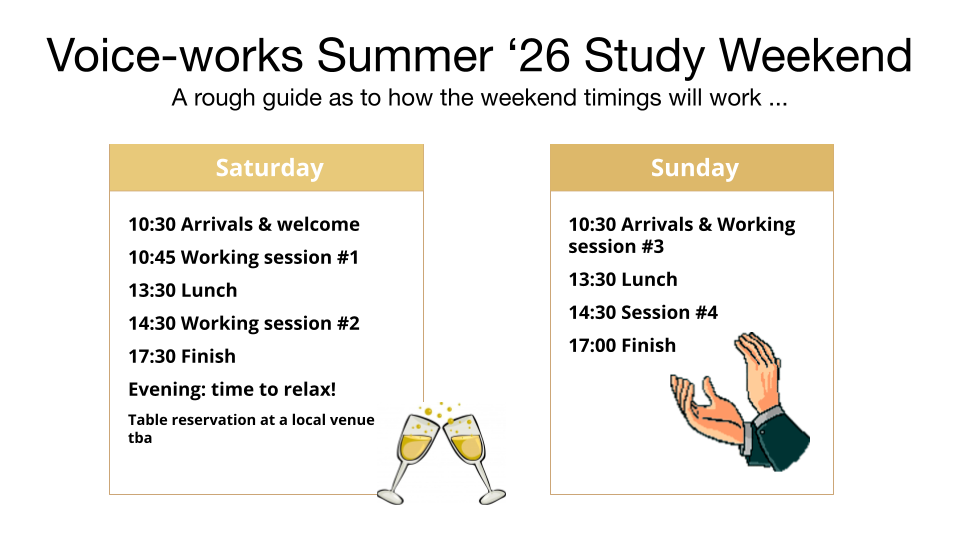
The Weekend at a Glance ...
Ready to join me?
How to Take Part / Sign Up
Singers
Singer places are limited to a maximum of five to keep the working group focused, connected, and supportive. If you’re applying as a singer, you’ll be invited to bring prepared repertoire and to take an active part over the weekend.
Singer places are £250 for the full weekend.
If spreading the cost would be helpful, you’ll also see an early bird payment plan available, offering the option to spread the fee across three instalments if booking before the end of February. As always with Voice-works events, places are limited to keep the working group focused and supportive.
Applications will close at the end of the spring term, on Saturday 28 March 2026, or earlier if places are filled.
Observers
Observers are very welcome to join us on either day or both 16/17 May 2026 at Ritchie Hall, Chandler’s Ford. You won’t simply be sitting at the back watching. Your presence matters, and many singers find that observing closely — listening, following scores, and reflecting — is a valuable way of learning.
If you’re not ready to sing this time, attending as an engaged observer is a meaningful way to take part in the weekend.
Observer day passes are available at £20.
Still thinking about it?
If you’d like to keep in touch to receive updates about this and other Voice School events, you’re very welcome to join my mailing list by completing the form to the right. I send updates carefully and thoughtfully, always with singers like you in mind.
Stay in touch
See you inside The Green Room
Once you’ve signed up for the Study Weekend, I’ll be in touch personally to gather your thoughts and share all the logistical details. This will be a day (or weekend!) where we collaborate closely to create an experience that truly serves us as singers — positive, supportive, and focused on your growth.
To help keep us connected before, you’ll have access to The Green Room, our private online space where you can ask questions, share ideas, and get encouragement from me and the other singers. (Currently, this is hosted on Facebook, but I’m always looking for ways to make this space as welcoming and easy to use as possible.)
I’ll be with you every step of the way.
"It's essential to work on something you're deeply interested in. Interest will drive you to work harder than mere diligence ever could. The three most powerful motives are curiosity, delight, and the desire to do something impressive. Sometimes they converge, and that combination is the most powerful of all."
Source: How to Do Great Work
